- Tax & Advisory
- UBO Declaration UAE
UBO Declaration in the UAE: Registers, Filing and Penalties
Every UAE company must identify the real people behind it, keep three separate registers, file them with its licensing authority and keep them current. The rules turn on a 25% ownership or control threshold, with a fallback where no one meets it. This guide covers who qualifies, what to file, and what happens when a company does not.
In this article
- Who counts as a beneficial owner
- The three registers
- Keeping the register current
- Who is exempt
- UBO Law offences and penalties
- Tracing ownership through a layered structure
- Who is responsible inside the company
- Records after the company ends
- Preparing for a request
- How UBO fits with your other obligations
- Common failures
- UBO and beneficial ownership in banking
- What good looks like
- How Avyanco helps
The UBO regime exists to answer one question: behind the companies, the holding structures and the nominee arrangements, which real people ultimately own or control this business? UAE companies are required to answer it, record the answer, file it and keep it current.
It is an ongoing obligation rather than a one-off form, and that is where most non-compliance comes from — registers prepared once at incorporation and never touched again.
Who counts as a beneficial owner
A beneficial owner, or Real Beneficiary, is a natural person — never a company. The test runs in a defined order:
- Ownership or control of 25% or more of the share capital or voting rights, held directly or indirectly. Indirect holdings are traced up through intermediate entities, so a person holding 25% through two layers still qualifies.
- Control by other means, where nobody meets the ownership threshold. This captures the person who can appoint or remove the majority of directors, or who otherwise directs the company's decisions regardless of shareholding.
- Senior management, as a fallback where neither of the above identifies anyone.
The fallback matters more than people expect. Widely held companies frequently have no 25% holder at all, and the answer is not "none" — it is the senior managing official, recorded as such.
The three registers
The obligation is not a single list. Companies must maintain, in most cases:
- Register of Beneficial Owners — the real people identified above, with their details and the basis on which each qualifies.
- Register of Partners or Shareholders — the legal owners on the share register, with holdings and dates.
- Register of Nominee Directors, where any director acts on another's instructions.
Each is filed with the company's licensing authority — the relevant registrar for a mainland company, or the free zone authority. Keep them at the registered office and be able to produce them on request.
Keeping the register current
This is the obligation most often missed. Changes to the information — a share transfer, a new shareholder, a change in control, or a change to a beneficial owner's own details — must be notified to the authority within the period the regulations specify, which is short. Confirm the current deadline with your licensing authority rather than working from memory, because it does not allow for a leisurely response.
The practical consequence: UBO maintenance should be attached to the events that trigger it. A company that updates its register only at renewal has usually been non-compliant for months without realising.
Who is exempt
The main exclusions are companies wholly owned, directly or indirectly, by federal or local government or their subsidiaries, and entities licensed in the DIFC and ADGM, which operate their own beneficial ownership regimes rather than the federal one.
Being in DIFC or ADGM is therefore not an exemption from beneficial ownership disclosure — it means a different rulebook applies. Companies assuming they have no obligation because they sit in a financial free zone are usually wrong.
UBO Law offences and penalties
Companies that fail to meet their obligations expose themselves, and in some cases their officers, shareholders and beneficial owners, to administrative penalties. The violations that attract them include:
- Failing to create or maintain the beneficial owner, shareholder or nominee director registers;
- Filing incomplete or inaccurate information with the registrar;
- Failing to notify changes within the required period;
- Failing to provide the registers or information when the authority requests them;
- Failing to appoint an authorised person resident in the UAE to provide the information on request;
- Failing to keep the data current and accurate on an ongoing basis;
- Failing to retain records for the required period after a company is dissolved or struck off.
Penalties escalate rather than arriving at full force. A first violation typically brings a written warning, with financial penalties for repetition, and continued or serious non-compliance can reach suspension of the licence or restrictions on the company's activity. The escalation is the point: the cost of ignoring a warning is materially higher than the cost of responding to it.
Tracing ownership through a layered structure
Simple structures are simple. The work is in the layered ones, and the method is the same every time: start at the UAE company and walk upward until you reach natural persons, multiplying the percentages as you go.
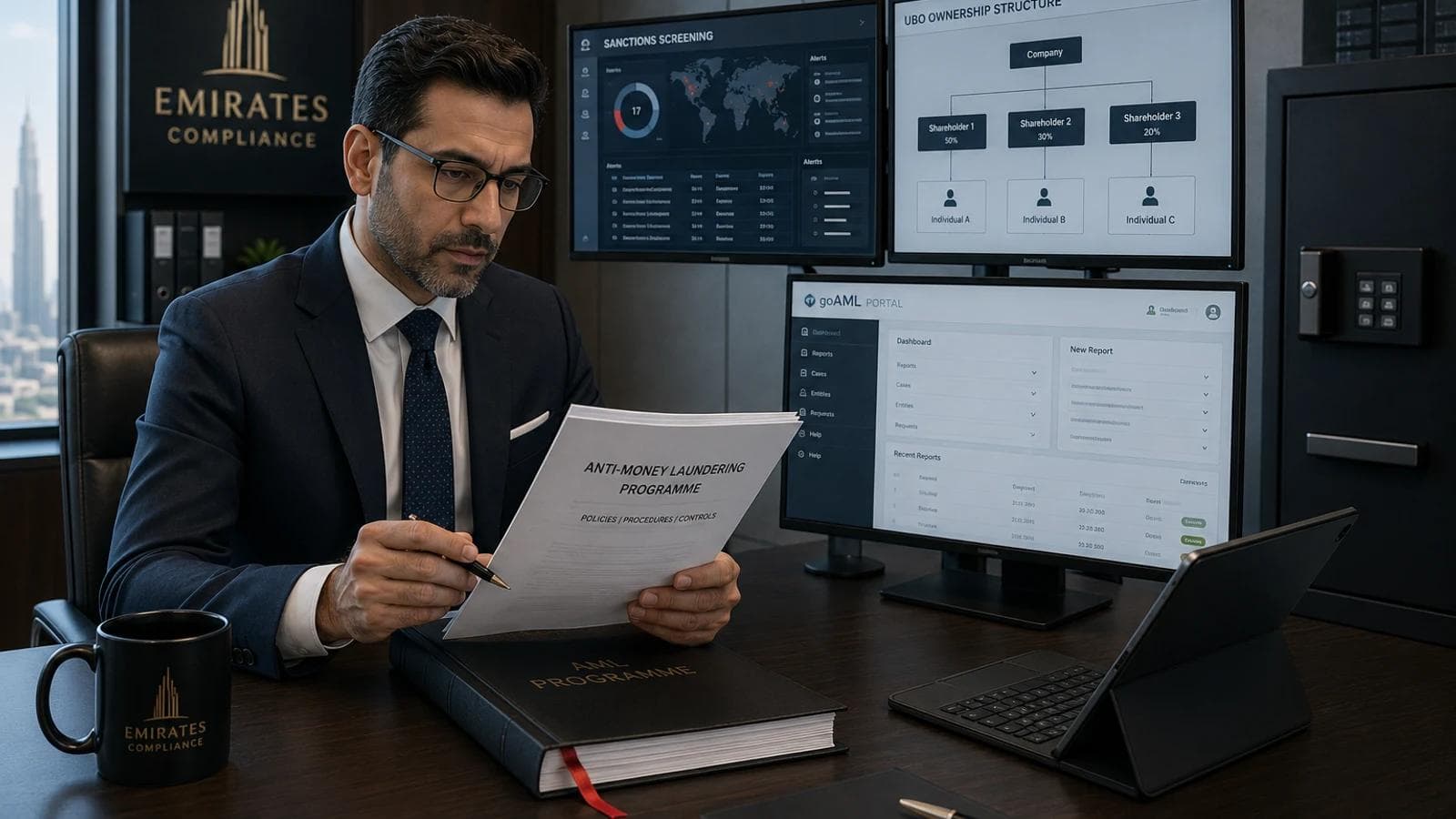
Take a UAE company owned 60% by an overseas holding company and 40% by an individual. The individual is at 40% and clearly qualifies. The holding company is not a beneficial owner — it is a corporate shareholder — so you look through it. If one person owns 50% of that holding company, their indirect interest in the UAE company is 30%, which is above the threshold and qualifies. If instead five people own 20% each, their indirect interests are 12% each and none of them qualifies on ownership. At that point you move to the control test, and if that identifies nobody, to senior management.
Two things trip people up. Percentages multiply through layers rather than carrying forward at face value. And a trust or foundation in the chain is not the end of the trail — the analysis continues to the people behind it, typically founders, trustees, protectors and beneficiaries depending on the arrangement.
Where the structure involves a holding company or a foundation, map the chain before filing rather than after a query. Reconstructing it under a deadline is where errors get made.
Who is responsible inside the company
The obligation sits with the company, but somebody has to discharge it. Companies are generally expected to designate a person resident in the UAE who can provide the registers and information to the authority on request, and that appointment should be recorded rather than assumed.
Need UAE tax advice?
Chartered accountants handling TRN, tax residency, withholding tax, and FTA correspondence for 4,000+ UAE businesses.
Talk to a tax specialistIn practice the responsibility usually falls to whoever handles corporate secretarial matters — internally, or an external provider. What matters is that the role is explicit. Where nobody owns the task, the register goes stale by default, and "we thought the other party was doing it" is not a defence that helps.
Records after the company ends
The obligation does not stop when trading does. Records must be retained for a period after a company is dissolved, liquidated or struck off, and that responsibility usually falls to whoever was administering the company at the end.
This is easy to overlook during a wind-down, when attention is on final accounts and licence cancellation. Build record retention into the closure checklist so the obligation is discharged deliberately rather than left with a departing administrator.
Preparing for a request
Authorities and banks both ask for this information, sometimes with little notice. A company that can respond within a day rather than a fortnight has usually done four things in advance:
- kept the three registers in one place, current, with the qualifying basis noted against each name;
- retained the underlying evidence — share certificates, transfer documents, constitutional documents for each entity in the chain, and identification for each named individual;
- documented the ownership chain as a diagram with percentages, so the reasoning is visible rather than having to be rebuilt;
- kept a log of what was filed and when, so notification compliance can be demonstrated rather than asserted.
None of that is difficult. It is simply easier done as you go than assembled under pressure, which is the recurring theme of this whole obligation.
How UBO fits with your other obligations
UBO does not sit on its own, and treating it as an isolated filing is why it goes stale.
It overlaps with AML compliance, where beneficial ownership is the same information regulators and banks are testing. It overlaps with banking, since a bank's diligence asks precisely the same question and inconsistency between what the bank holds and what the registrar holds invites questions. And it overlaps with corporate housekeeping, because every share transfer, director change and restructuring is a UBO event.
The businesses that stay compliant are the ones that treat a change in ownership as automatically triggering a UBO review, rather than remembering the register at licence renewal.
Common failures
- Naming a company as the beneficial owner. The register requires natural persons; a corporate shareholder is recorded on the shareholder register instead.
- Stopping at the first layer. Indirect holdings must be traced up through the structure.
- Leaving it blank where no one holds 25%. The control test and then the senior management fallback apply.
- Forgetting nominee arrangements. Where a director acts on instructions, the nominee register applies.
- Updating only at renewal, so changes sit unreported for months.
- Assuming a free zone means exemption. Only specific categories are excluded, and DIFC and ADGM have their own regimes rather than none.
UBO and beneficial ownership in banking
Worth understanding that the registrar is not the only party asking. Every bank onboarding a UAE company runs its own beneficial ownership analysis, and so does any counterparty conducting serious diligence — an acquirer, a large customer, a lender.
They are answering the same question, but they will not simply accept your register. Banks generally want to see the underlying evidence: constitutional documents for each entity in the chain, share registers, and identification for each individual named. Where what the bank concludes differs from what sits at the registrar, that discrepancy becomes the conversation, and it is a slow one.
The practical implication is to keep one version of the truth. Companies that maintain a single, evidenced ownership pack — used for the registrar filing, the bank, and any diligence request — spend far less time reconciling than those who assemble a fresh answer for each audience.
What good looks like
A company in good order can, at any time, produce three current registers, show the ownership chain traced up to named individuals with the basis on which each qualifies, evidence that the last change was notified within the deadline, and name the UAE-resident person responsible for providing the information. That package answers the registrar, the bank and any counterparty carrying out diligence, which is the practical value of doing it properly.
How Avyanco helps
We identify the beneficial owners correctly — including where the structure is layered and where nobody meets the 25% threshold — prepare and file the three registers, and put a process in place so changes are notified within the deadline rather than discovered at renewal. Where the ownership chain is genuinely complex, we map it before filing rather than after a query.
UBO Declaration in the UAE — FAQs
01What is a UBO declaration in the UAE?
02Do all UAE companies need to file UBO information?
03What are the three UBO registers?
04What if nobody owns 25% or more?
05How quickly must UBO changes be reported?
06Are DIFC and ADGM companies exempt from UBO rules?
07What penalties apply for UBO non-compliance?
08What are the most common UBO filing mistakes?
09How do I trace beneficial ownership through a holding company?
10Will my bank accept the UBO register I filed?
In this article
- Who counts as a beneficial owner
- The three registers
- Keeping the register current
- Who is exempt
- UBO Law offences and penalties
- Tracing ownership through a layered structure
- Who is responsible inside the company
- Records after the company ends
- Preparing for a request
- How UBO fits with your other obligations
- Common failures
- UBO and beneficial ownership in banking
- What good looks like
- How Avyanco helps